Retail versus Commodity Events (Automobiles)


Hi,

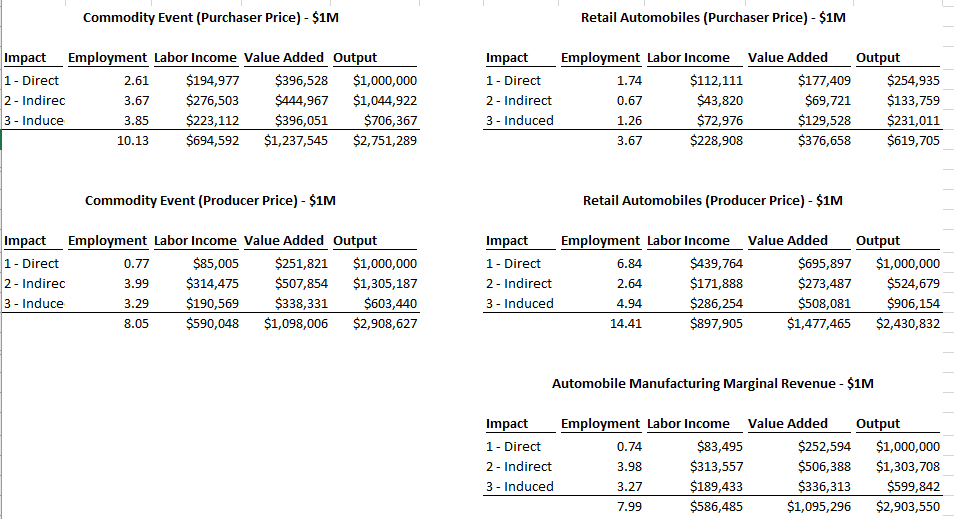
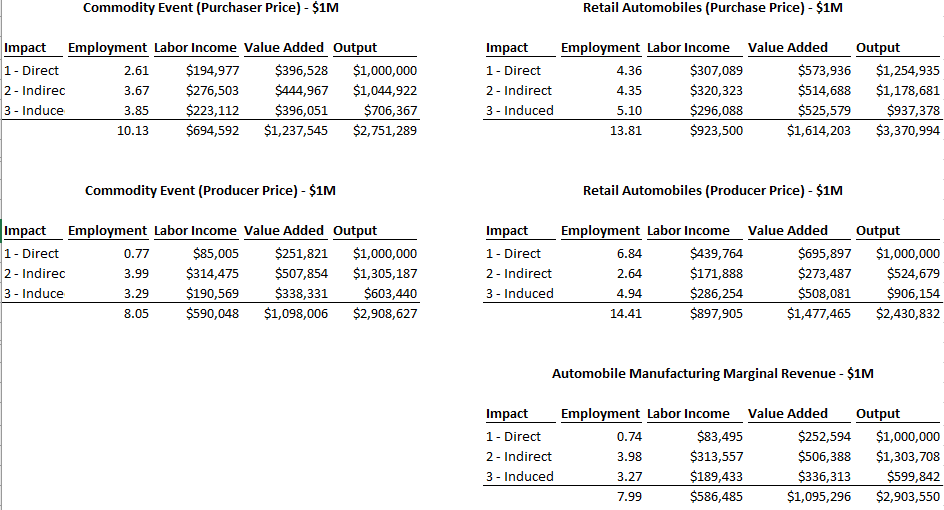
Our team is still confused about the difference between a retail industry change and a commodity change. The attached image shows results after modeling $1M to either retail, commodity, or manufacturing. A $1M automobile commodity change yields a value add of $1.2M, while a $1M industry retail change to automobiles yields a value add of $1.6M. Our questions are the following:

1. What are the differences between modeling $1M to a commodity change for automobiles and modeling $1M to retail automobiles? We were told yesterday that retail would not include the final cost of the good, but in the table above, the results for a retail change are higher than the results for a commodity change. 

2. From the results alone, it appears that retail captures the value added in every upstream link in the supply chain.  Why then, are the commodity results and retail results not equal?

Thank You,

Luke

Was this post helpful?
0 out of 0 found this helpful

Comments

4 comments

  • Official comment

    Hey Luke -

    It sounds like you have a pretty complicated project. You might consider a project consultation to get all of your questions answered. Just email support@implan.com for more information on that.

    1. The file with the margins is located in the article Margins & Deflators. Heading to the Commodities tab and then scrolling to 3402 - Retail services Motor vehicle and parts dealers you see that the margin is as Maria indicated: 0.254935305.

    2. For retail, the purchaser price doesn't include the price of the goods purchased, as IMPLAN doesn't know what was bought from the retailer. This is when you see your direct output = to the margins. The portion of that $1M the retailer gets to keep. When you use producer price, you are telling IMPLAN this $1M is all going to the retailer. You can see how it plays out by using the filters and examining your results for each of the scenarios you ran.

    3. No. When you run $1M through industry retail, you are saying the retailer gets that $1M. When you run a commodity through auto manufacturing with producer price, IMPLAN is going to split the $1M in direct across the value chain - manufacturing, retail, wholesale, and transport. Again, I would suggest looking at the details in your results to see where that $1M is getting allocated in each scenario.

  • Hi Luke,

    Could you provide a screenshot of how these events have been setup? You indeed should see only a portion of the $1M of Retail Automobile Sales (Purchaser Price) as Direct Output. The 2019 Margin for the auto dealership retail industry is 0.254935305448679, so I'd expect a Direct Output of about $254,935.

    After running these events on our end, it looks like your results are a combination for the retail Industry Purchase Price results and the Commodity Purchaser Price results. 

    Thank you,
    Maria 

    0
  • Hi Maria,

    Thank you for catching my mistake! You are correct, a $1M allocation to Retail Automobile Sales produces $254,935 in direct effects. So let me refine my list of questions:

    1. Where can we find the margins you speak of? I found the 2019 margin data for commodities and see 24.6%

    2. So modeling a retail event where margins = "purchaser price" only includes the markup of a good? And modeling a retail event where margins = "producer price" includes the markup of the good at the retail level, plus all the impacts from the supply chain?

    3. If my interpretation is correct, then shouldn't the results from a $1M commodity event  for automobiles (purchaser price) equal the results from a $1M industry event in automobile retail (producer price)?

    Thanks

    0
  • Update: We've since written an article detailing these scenarios because we know others would benefit from this concept of comparing each Event setup - 

    https://implanhelp.zendesk.com/hc/en-us/articles/1260804533829-How-Output-is-Analyzed-in-Industry-and-Commodity-Events-with-without-Margins

    0

Please sign in to leave a comment.