
INTRODUCTION
If you haven’t heard yet, IMPLAN now offers the capability to model both backward and forward linkages. Why you ask? Because we not only want to look at the supply chain of Industries (backward or upstream), but we want to look at the supply driven aspect of the industries that purchase from these Industries (forward or downstream).
And also if you haven’t heard, 6-7 is kind of trending. Why? Well, obviously it’s because Industry 67 is beet sugar manufacturing in IMPLAN. And if you are thinking that beet sugar isn’t important, realize that it’s about 20% of total sugar production across the globe. You might not realize it, but it shows up in all sorts of delicious places. More on that in a moment.
BACKWARD
Traditional Input-Output analysis uses the Leontief Inverse to examine the supply chain of an Industry or Industries. So, for Industry 67 - Beet sugar manufacturing, this represents all the inputs required to manufacture beet sugar. Let’s first run an Industry Contribution Analysis Event for this Industry in the U.S.
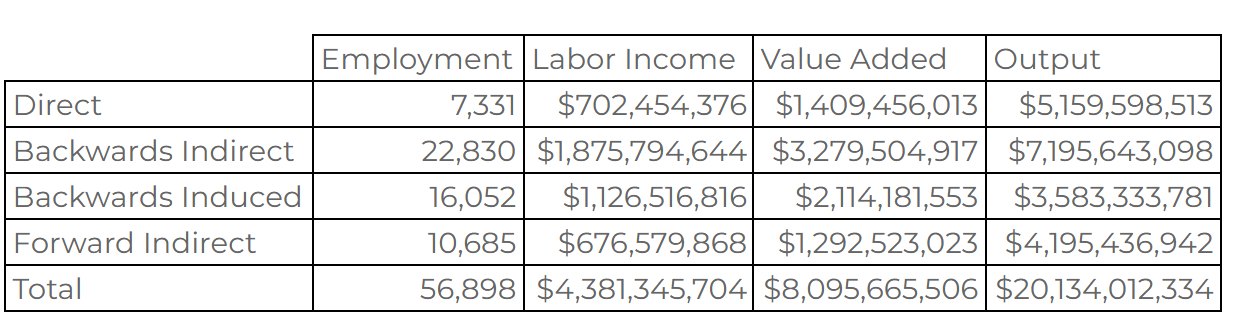
Our Direct results tell us that there are 7,331 jobs in this Industry across the country and it’s responsible for over $5B in Output. The backwards supply chain supporting it (Indirect Effect) is 22,830 people with $7B in Output. And the households working in the Direct and Indirect effect support another 16,052 people with over $3B in Output.
Heading to the Output tab on the results page, sort by the Indirect Industry by Impact to see what Industry 67 is buying. In order to produce beet sugar, they purchase from 9 - Sugarcane and sugar beet farming; 19 - Support activities for agriculture and forestry; 162 - Pesticide and other agricultural chemical manufacturing; 427 - Insurance agencies, brokerages, and related activities; and 399 - Truck transportation, to round out the top five.
FORWARD
Now, if you are anything like me, you have never walked into the grocery store and said “I’m here for a bag of beet sugar.” However, if the label on the sugar package doesn’t specifically say “pure cane sugar,” I might end up with just that. Here we can run a Downstream Industry Contribution Analysis using the guide in IMPLAN to see what Industries are using beet sugar as an input to production.
Of course, I will be selecting the entirety of the U.S., 100% of the Industry, and 67 as my Industry of interest.
After this runs, let’s head over to the In Depth Overview on the summary tab. This view will look eerily similar to the traditional backward linkages results.
Comparing this Economic Indicators by Impact table with the same table from our backwards analysis, shows us that the Direct Effect line is exactly the same. This is because we ran 100% of the Industry looking backwards as well as forwards. What is different, however, is the Indirect Effect line. That is because the Indirect Effects here represent the forward linkages! This shows all the Industries that are purchasing from the beet sugar manufacturing Industry in the U.S.
Heading again to the Output tab on the results page, sort by the Indirect Industry by Impact to see who is buying from Industry 67. In this case, the top five Industries are 68 - Sugar cane mills and refining; 88 - Bread and bakery product, except frozen, manufacturing; 71 - Confectionery manufacturing from purchased chocolate; 90 - Dry pasta, mixes, and dough manufacturing; and 59 - Other animal food manufacturing.
BACK AND FORTH
To bring this all together, I create a table that has the Direct Effect (remember this is identical between the backward and forward projects), the Backwards Indirect, Backwards Induced, and the Forward Indirect, to give us a new total. This tells us that there are 56,898 jobs tied specifically to Industry 67 - Beet sugar manufacturing, with a Labor Income of $4.4B, Value Added of $8.1B, and Output of $20.1B.
SIX-SEVEN
Beet sugar manufacturing plays a critical role in the economy by creating strong backward linkages to agriculture and forward linkages to food processing and distribution. These connections amplify its impact beyond the factory floor, supporting jobs and supply chains across multiple sectors. And now we finally know why all the kids are fascinated with 6-7!
RELATED ARTICLES
Forward Thinking: A New Dimension in Impact Analysis
WEBINAR
Discover the Power of IMPLAN’s Forward Linkages Suite
Written November 24, 2025